



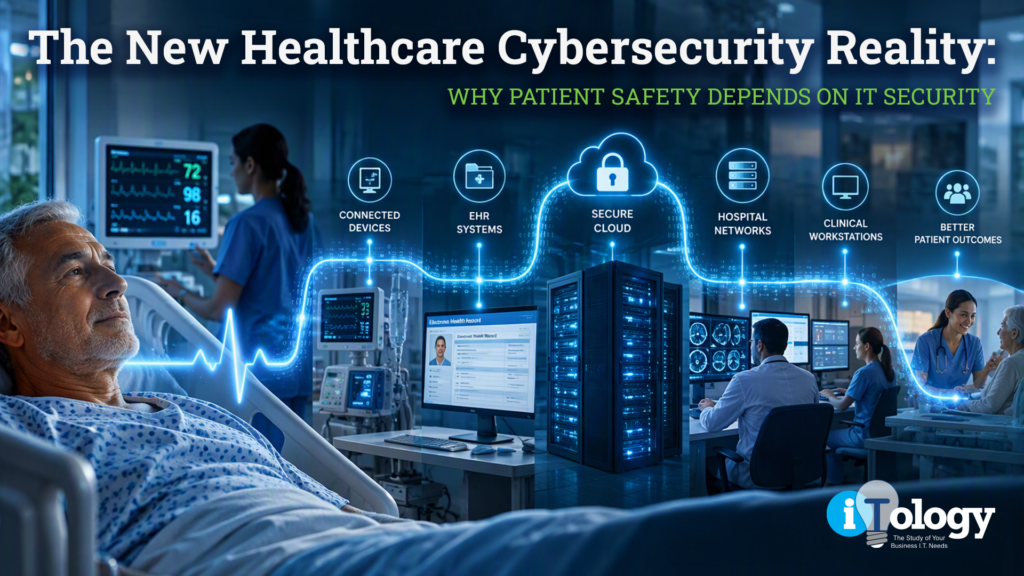
Healthcare cybersecurity is no longer just an IT issue. It’s a patient safety issue.
For years, hospital and clinic leaders viewed cybersecurity as a compliance requirement, a technology concern, or simply another item on the annual budget. Today, that perspective is changing rapidly. As healthcare organizations become more dependent on electronic health records (EHRs), connected medical devices, cloud platforms, telehealth services, and third-party vendors, cyberattacks have evolved from business disruptions into direct threats to patient care.
The reality is clear: when critical healthcare systems go down, patient care suffers.
Ransomware, phishing campaigns, business email compromise, and supply chain attacks continue to target healthcare organizations because attackers understand a difficult truth. Hospitals and clinics cannot afford downtime. Patient care must continue, making healthcare one of the most attractive targets for cybercriminals. Industry analysts continue to identify ransomware, identity-based attacks, and third-party vendor risk among the most significant cybersecurity concerns facing healthcare providers in 2026.
For healthcare executives, administrators, and practice managers, cybersecurity is no longer simply about protecting data. It is about protecting patients.
How Cyberattacks Directly Impact Patient Care
Imagine a typical morning in a busy hospital.
Patients are arriving for scheduled procedures. Physicians are reviewing charts. Nurses are administering medications. Lab technicians are processing tests. Every department relies on digital systems to deliver safe and efficient care.
Now imagine those systems suddenly become inaccessible.
The EHR is locked. Lab systems stop communicating. Scheduling platforms fail. Clinical staff must switch to manual documentation. Phone lines become overloaded. Critical patient information becomes difficult to access.
This scenario is no longer hypothetical.
Recent healthcare cybersecurity research shows that cyberattacks frequently disrupt patient care operations, causing delayed procedures, interrupted workflows, longer hospital stays, and increased operational risk. Healthcare organizations report that ransomware and supply chain attacks can directly affect treatment timelines and clinical decision-making.
When clinicians cannot access a patient’s medical history, medication records, allergies, imaging studies, or test results, patient safety risks increase significantly. Emergency departments may need to divert patients to other facilities. Surgeries may be postponed. Diagnostic testing may slow down. Communication across care teams becomes more challenging.
The healthcare industry has reached a point where cyber resilience and clinical resilience are closely connected. If a provider cannot access the systems that support care delivery, the quality and speed of care are inevitably affected.
That is why healthcare leaders increasingly discuss cybersecurity in the same conversations as patient safety, business continuity, and operational excellence.
Why Healthcare Remains a Prime Target
Healthcare organizations possess something cybercriminals highly value: data and urgency.
Patient records contain personal information, insurance information, financial data, and clinical history. This information can be sold, exploited for identity theft, or used as leverage in extortion attempts.
At the same time, healthcare environments present unique challenges that attackers know how to exploit:
- Legacy systems that cannot always be patched immediately
- Complex networks of connected medical devices
- Large and diverse user populations
- Third-party vendors and business associates with system access
- Mission-critical operations that cannot tolerate extended outages
The widespread disruption caused by third-party incidents in recent years has highlighted how dependent healthcare organizations have become on external vendors and service providers. Industry experts continue to identify vendor and supply chain cybersecurity risk as one of healthcare’s fastest-growing concerns.
Even a well-protected hospital can be impacted if a trusted technology partner experiences a breach.
This expanding attack surface means healthcare leaders must think beyond their own networks and consider security across their entire ecosystem.
The True Cost of Downtime in Healthcare
Many organizations still evaluate cybersecurity investments by comparing them against potential regulatory fines or breach notification costs.
While those costs matter, they often represent only a small portion of the total impact.
The most expensive consequence of a cyberattack is frequently operational downtime.
When critical systems become unavailable, healthcare organizations face cascading challenges:
Lost productivity. Staff spend valuable time working around unavailable systems instead of focusing on patient care.
Scheduling disruptions. Appointments, procedures, and surgeries may need to be postponed or rescheduled.
Revenue cycle interruptions. Billing, claims processing, and reimbursement activities can slow or stop entirely.
Patient experience challenges. Delays, communication issues, and canceled services can reduce patient satisfaction and trust.
Reputation damage. Patients increasingly expect healthcare providers to safeguard both their information and the availability of their services.
Research continues to show that operational disruption and downtime account for a substantial share of healthcare cyberattack costs. Organizations report significant financial losses associated with interrupted operations, idle staff, and recovery efforts.
For healthcare executives, a critical question is not whether an organization can prevent every attack. The more important question is whether the organization can continue caring for patients effectively during and after a cyber incident.
Security Controls Every Clinic and Healthcare Organization Should Implement
While the threat landscape continues to evolve, many successful attacks still exploit basic security weaknesses.
The good news is that healthcare organizations can significantly reduce risk by focusing on proven cybersecurity fundamentals.
Multi-Factor Authentication (MFA)
Passwords alone are no longer sufficient.
Multi-factor authentication provides an additional layer of protection by requiring users to verify their identity through a second factor, such as a mobile application or security key.
Because credential theft remains one of the most common attack methods, MFA is often one of the highest-impact security improvements a healthcare organization can implement.
Comprehensive Employee Security Awareness Training
Healthcare employees remain a primary target for phishing attacks.
A single malicious email can create an entry point for ransomware or account compromise.
Regular training helps staff identify suspicious messages, recognize social engineering attempts, and report potential threats before damage occurs.
Security awareness should be treated as an ongoing program rather than a once-a-year compliance exercise.
Endpoint Detection and Response (EDR)
Traditional antivirus tools alone are no longer enough.
Modern Endpoint Detection and Response solutions continuously monitor devices for suspicious behavior and can help security teams identify and contain attacks before widespread damage occurs.
For healthcare organizations with limited internal security resources, managed detection and response services can provide around-the-clock protection.
Secure and Tested Backups
Backups remain one of the most important safeguards against ransomware.
However, simply having backups is not enough.
Healthcare organizations should regularly test backup restoration procedures to ensure critical systems and patient data can be recovered quickly during an incident.
A backup that has never been tested may fail when it is needed most.
Vendor Risk Management
Every third-party relationship introduces potential risk.
Healthcare leaders should evaluate vendors based on security controls, compliance practices, access permissions, and incident response capabilities.
Vendor assessments should become a routine component of procurement and ongoing risk management.
Incident Response Planning
When an attack occurs, confusion can become as dangerous as the attack itself.
A documented incident response plan helps organizations know who makes decisions, how communication occurs, and what actions must be taken during a cybersecurity event.
Organizations that regularly test incident response plans are often able to recover faster and minimize operational disruption.
Cybersecurity as a Patient Safety Strategy
Healthcare organizations spend significant time planning for natural disasters, clinical emergencies, and operational disruptions.
Cyber incidents deserve the same level of preparedness.
The organizations demonstrating the strongest resilience today are not necessarily those spending the most money on cybersecurity. They are the ones integrating security into everyday operations, executive planning, vendor management, and patient care workflows.
Cybersecurity is no longer an isolated IT function. It is a business function, a compliance function, and increasingly, a patient safety function.
As healthcare continues its digital transformation, leaders who prioritize cybersecurity will be better positioned to protect patients, maintain operational continuity, and preserve trust within their communities.
Patient Safety and Cybersecurity Are No Longer Separate Conversations
The healthcare threat landscape is becoming more sophisticated, and the consequences of cyberattacks continue to grow. Ransomware, identity-based attacks, phishing campaigns, and third-party breaches can impact far more than data. They can disrupt care delivery, delay treatment, and create real patient safety concerns.
For hospitals, medical practices, specialty clinics, and healthcare systems, cybersecurity must be viewed as an essential component of patient care.
Because when healthcare technology stops working, patient care doesn’t simply become less efficient. It becomes more vulnerable.
Schedule a Healthcare Cybersecurity Assessment
Is your organization prepared for today’s healthcare cyber threats?
A comprehensive healthcare cybersecurity assessment can identify security gaps, evaluate vendor risks, strengthen compliance efforts, and improve your organization’s ability to protect both patient data and patient care.
Contact us today to schedule a healthcare cybersecurity assessment and build a stronger foundation for cyber resilience.
Frequently Asked Questions
Why is cybersecurity important for patient safety?
Cybersecurity protects the systems clinicians rely on to access patient records, diagnostic data, medication information, and care workflows. When those systems are compromised, patient care may be delayed or disrupted.
What is the biggest cybersecurity threat facing healthcare organizations?
Ransomware remains one of the most significant threats, followed by phishing attacks, credential theft, and third-party vendor risks.
How much can healthcare downtime cost?
Downtime can result in lost productivity, delayed procedures, billing interruptions, recovery expenses, reputational damage, and patient care disruptions. Studies consistently identify operational downtime as one of the largest costs associated with healthcare cyber incidents.
What security controls should every clinic implement?
At minimum, clinics should deploy multi-factor authentication, employee security awareness training, endpoint detection and response, secure backups, vendor risk assessments, and an incident response plan.
